Anthony de Mello in “Awareness”
Tag Archives: Awareness
“We begin first with things, with an awareness of things; then we move on to an awareness of thoughts (that’s the me); and finally we get to an awareness of the thinker. Things, thoughts, thinker. What we’re really searching for is the thinker. Can the thinker know himself? Can I know what “I” is? Some of these mystics reply, “Can the knife cut itself? Can the tooth bite itself?…Can the “I” know itself?”
11 Nov“The chances that you will wake up are in direct proportion to the amount of truth you can take without running away.”
1 Nov– Anthony de Mello in “Awareness”
“You are never so good as when you have no consciousness that you’re good. Or as the great Sufi would say, ‘A saint is one until he or she knows it.”
1 NovAnthony de Mello in “Awareness”
Awareness – by Anthony de Mello
25 Oct
By far one of the most impactful books I have ever read, is “Awareness” by Anthony de Mello. I was first introduced to it on a car-ride back from SLC airport to company head quarters by a dear colleague, and now a best friend, Josh. I don’t know how it came up, but he mentioned the book and I recall him saying “when we renounce something, we are permanently attached to it.” “Yeah,” I thought. “That sounds so Fing right.” Anyone who has dieted, knows what I am talking about.
Over the course of the following months, I saw Josh completely change, not in his persona, but in his relationship to himself. It was insane and awesome. Somewhere along the way, I picked up the book.
The book itself is not written by Anthony de Mello, but by a colleague of his, J. Francis Stroud, who faced the task of “maintaining the spirit of [de Mello’s] live words and sustaining his spontaneity with a responsive audience on the printed page,” after his death.
Anthony himself, was an Indian Jesuit priest and psychotherapist. Stroud was also a Jesuit priest. Eleven years after de Mello died the Catholic church reviewed his work and found some of his theological teaching to be ‘incompatible with the Catholic faith.’ Somehow, this makes me like him even more.
Fun fact: Jesuits are members of a male, christian congregation of the Catholic Church called the “The Society of Jesus.” Founded by Ignatius of Loyola, who had a strong military background, the members have a willingness to accept orders anywhere in the world and to live in extreme conditions where required. They are sometimes called “God’s Soldiers” or “God’s Marines.”
“AWARENESS” MAIN MESSAGE
We are asleep. We don’t want to wake up because it is painful. In awareness is healing; in awareness is truth; in awareness is salvation; in awareness is spirituality; in awareness is growth; in awareness is love; in awareness is awakening.
In order to wake up:
- Realize that you don’t want to wake up.
- Unlearn, listen and challenge your whole belief system. Find truth, not from words, but from an attitude of openness and willingness. Suffering points to an area of growth.
- Don’t try to change things, try to understand them. What you judge you cannot understand.
- Practice self-observation (watching everything around you as if it were happening to someone else) and become aware. Step outside of yourself and observe. Awareness means to watch, to observe what is going on within you and around you. First, we become aware of things, then we become aware of thoughts, and finally we get to the awareness of the thinker.
- Drop your illusions. When your illusions drop, you are in touch with reality.
Comments on waking up
- The chances of waking up are in direct proportion to the amount of truth you can take without running away.
- When you’re waking up, you experience a great deal of pain.
When you wake up:
- You will fear no one and you will fear nothing because you are perfectly content to be nobody.
- When you awaken, when you understand, when you see, the world becomes right.
ILLUSIONS THAT DE MELLO REFERENCES
- There is no such thing as charity; it is all self interest
- Things don’t need to be fixed. They need to be understood. If you understood them, they’d change.
- Your illusions of other people will constantly crash against reality. See through people and start by seeing through yourself.
- Who am I? What is I? Who is living inside of me? When you identify “I” with the “me” suffering begins.
- Anytime you have a negative feeling towards anyone, you are living in an illusion. There is something seriously wrong with you.
- Loneliness is not cured by human company. Loneliness is cured by dropping illusions and coming into contact with reality.
- No situation in the world justifies a negative feeling.
- We see people not as they are, but as we are.
- The one who knows, does not say; the one who says, does not know.
- Happiness is not the same as excitement; it’s not the same as thrills.
Four steps to wisdom:
- Get in touch with negative feelings that you are not even aware of.
- Understand that the feeling is in you, not in external reality.
- Never identify with that feeling. It has nothing to do with the “I”. These things come and go.
- Rather than ask “How do you change things?” ask “How do I change myself?” When you change , everything changes.
COMPARED TO BUDDHISM
Like Buddhism, de Mello says often “Life is always changing” and talks often about how our inability to understand that causes suffering. Also like Buddhism, de Mello highlights the suffering caused by clinging. He says “When you cling, life is destroyed. When you hold onto anything, you cease to live.” And again, “there’s another demon too, who’s doing the filtering. It’s called attachment, desire, craving. The root of sorrow is craving.”
COMPARED TO AYN RAND
Like “Atlas Shrugged” and “Fountainhead”, de Mello believes that there is no such thing as charity – that it is all self-interest, at its best, it is enlightened self interest.
Buddhism
15 JunPersonal Intro
As I researched Buddhism, I found that I was much more attracted to the philosophical applications than the religious ones (not very surprising if you know me). My attraction towards Buddhism started around 2 – 3 years ago, and has grown increasingly. Mostly, I have been attracted to the encouragement within Buddhism to question teachings, take nothing on blind faith, and to realize and experience truth for oneself. Meditation has also started to play a significant role in my life, and most recently, my 10 day silent Vipassana mediation (which is Buddhist in its origin), further increased my curiosity in Buddhism through its teachings and discourses.
1) Craving and Desire: My Bad Habit
During my 10-day Vipassana, I was introduced to the “truth” that “clinging to” or “craving of” positive sensations causes suffering (one of Buddhism’s Four Noble Truths). I had somewhere along the way already gained the understanding that “hate and aversion” cause suffering, and although I had connected the dots of how my high expectations often led to disappointment (and occasional pouting), I had never realized the full extent and frequency of my internal craving habit. This pattern of romanticizing a future life-event, and craving its imagined outcome was addictive and captivating; however, immense disappointment frequently followed when life unfolded with its own set of plans.
Note: I use “Craving”, “Desire”, “Clinging” and “Attachment” interchangeably. I also do the same with “Aversion” and “Hate”
2) No Reincarnation? No Kidding.
The desire to “know what I am talking about” is a central drive to my existential research. I was delighted, then, to discover my false perceptions about Buddhism and reincarnation. Despite what I thought, Buddhist believe in rebirth, not reincarnation. The very important difference here, is that Buddhists believe in the “no-self”, which means there is no unique, individual soul or essence that carries over from one lifetime to the next. Do I believe in rebirth? Reincarnation? Time between lifetimes? The self-soul? The no-self?
3) The No-self
This concept in Buddhism is challenging to understand, yet an essential understanding for practitioners. I am open to assistance in understanding”what” is actually reborn if there is “no self.” One school of Buddhism, Theravada considers “no-self” to mean that an individual’s ego or personality is a delusion. In another, “emptiness’ is applied, meaning all phenomena are void of intrinsic identity and take identity only in relation to other phenomena.[3]
4) Enlightenment, Liberation, Nirvana, Awakening
The clarification of terms here was really important to me, because “enlightenment”, “nirvana”, and “liberation” are so often interchanged. Within all of that there is some “awakening”. The distinction amongst them all still remains a bit unclear.
5) Question/Theory?: Is it me, or is 30-35 a ridiculously important time for profound transformations?
6) Applied Buddhism
Currently, I look forward to becoming aware of my “craving” when it happens, and practicing an “equanimous” approach towards it. I also look forward to integrating compassion meditation into my daily meditation routine.
Check out my Buddhism Conceptual Organization Chart
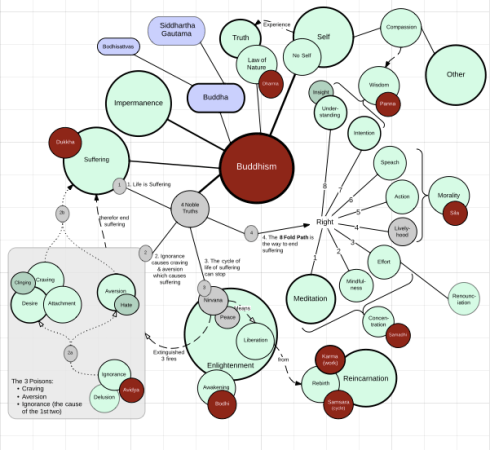
BUDDHISM
Buddhism is defined as a non-theist religion and at times considered a philosophy. It is recognized as one of the fastest growing religions in the world. [1]
TEACHINGS
The teachings of Buddhism can be summed into:
- lead a moral life
- be mindful and aware of thoughts and actions
- develop wisdom and understanding.{2]
FOUR NOBLE TRUTHS
There are Four Noble Truths which are regarded as central to the teachings of Buddhism. The four truths are:
- Suffering (dukkha) is always a part of life.
- Suffering is caused by the 3 “poisons” or “fires”: 1) Aversion to pain and death. 2) Craving/desire and the anxiety of and holding onto things, and 3) the root of the first two, ignorance.
- The end of suffering is possible.
- The path to ending all suffering is achieved through a set of eight interconnected factors or conditions.
THE PATH TO END SUFFERING
Buddhists believe there are eight significant dimensions of one’s behavior that operate in dependence on one another and define a complete path, or way of living. In summary, the Noble 8-fold Path is being moral (through what we say, do and our livelihood), focusing the mind on being fully aware of our thoughts and actions (this is where meditation comes into play), and developing wisdom by understanding the Four Noble Truths and by developing compassion for others.
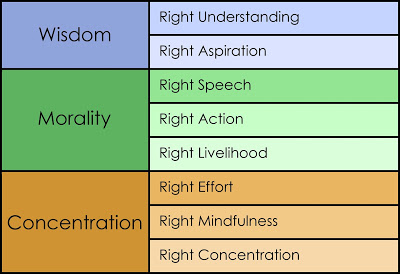
THREE MARKS OF EXISTENCE
Three Marks of Existence are impermanence, suffering, and not-self.
THE FOUR IMMEASURABLES
The “Four Immeasurable Minds” in Buddhism are without egotism, and are love, compassion, joy, and equanimity.
THE 5 PRECEPTS
The moral code within Buddhism is the precepts, of which the main five are: not to take the life of anything living, not to take anything not freely given, to abstain from sexual misconduct and sensual overindulgence, to refrain from untrue speech, and to avoid intoxication, that is, losing mindfulness.
With regards to the “not taking the life of anything living”, I was excited to learn that vegetarianism is not required in all Buddhist practices.
THE THREE JEWELS of which Buddhist take refuge in are:
- The Buddha
- The Dharma – Law of nature/reality
- The Sangha – monk community or community of those in Buddhism
WHERE & SCHOOLS

Two major branches of Buddhism are generally recognized: Theravada and Mahayana.
REBIRTH, NOT REINCARNATION
According to Buddhism there is ultimately “no-self” is no such thing as a self independent from the rest of the universe; therefor, Buddhism rejects the concepts of a permanent self or an unchanging, eternal soul, as it is called in Hinduism and Christianity. In Buddhism, Rebirth refers to a process whereby beings go through a succession of lifetimes as one of *5 (Theravadins) or 6 (other schools) possible forms of sentient life (1. hellish beings, 2. ghosts, 3. animals, 4. humans, 5. Gods and angels, *6. Asuras: lowly gods and demons, ). Each reincarnation is considered to happen back to back, and is determined by Karma.
In Tibetan Buddhism, there is an intermediate state, a “Bardo” between one life and the next.
ENLIGHTENMENT, NIRVANA & LIBERATION
It varies depending on the school of buddhism, but originally, enlightenment (Bodhi) and achieving nirvana meant the same thing. Somewhere down the line, the Mahayana school applied nirvana to the elimination of aversion and craving, and enlightenment as the further elimination of delusions and ignorance. I recall the Vipassana teacher saying that for householders (non-monk Buddhists), liberation is possible, but not enlightenment, but again, the distinction amongst these terms is unclear.
BUDDHA
Buddhism teachings started with Siddhartha Gautama, who is commonly known as the Buddha. Buddha means “the awakened one” and refers to all enlightened beings, past, present and future.
At the age of 35, Guatama Buddha famously sat in meditation under a sacred fig tree — known as the Bodhi tree — in the town of Bodh Gaya, India, and vowed not to rise before achieving enlightenment. After many days, he arose as a fully enlightened being
References
[1] “Buddhism” – Wikipedia (http://en.wikipedia.org/wiki/Buddhism)
[2] “Basic Buddhism Guide” – BuddhaNet (http://www.buddhanet.net/e-learning/5minbud.htm)
[3]”Buddhism Basic Beliefs” – About.com (http://buddhism.about.com/od/basicbuddhistteachings/a/basicshub.htm)
Vipassana Meditation
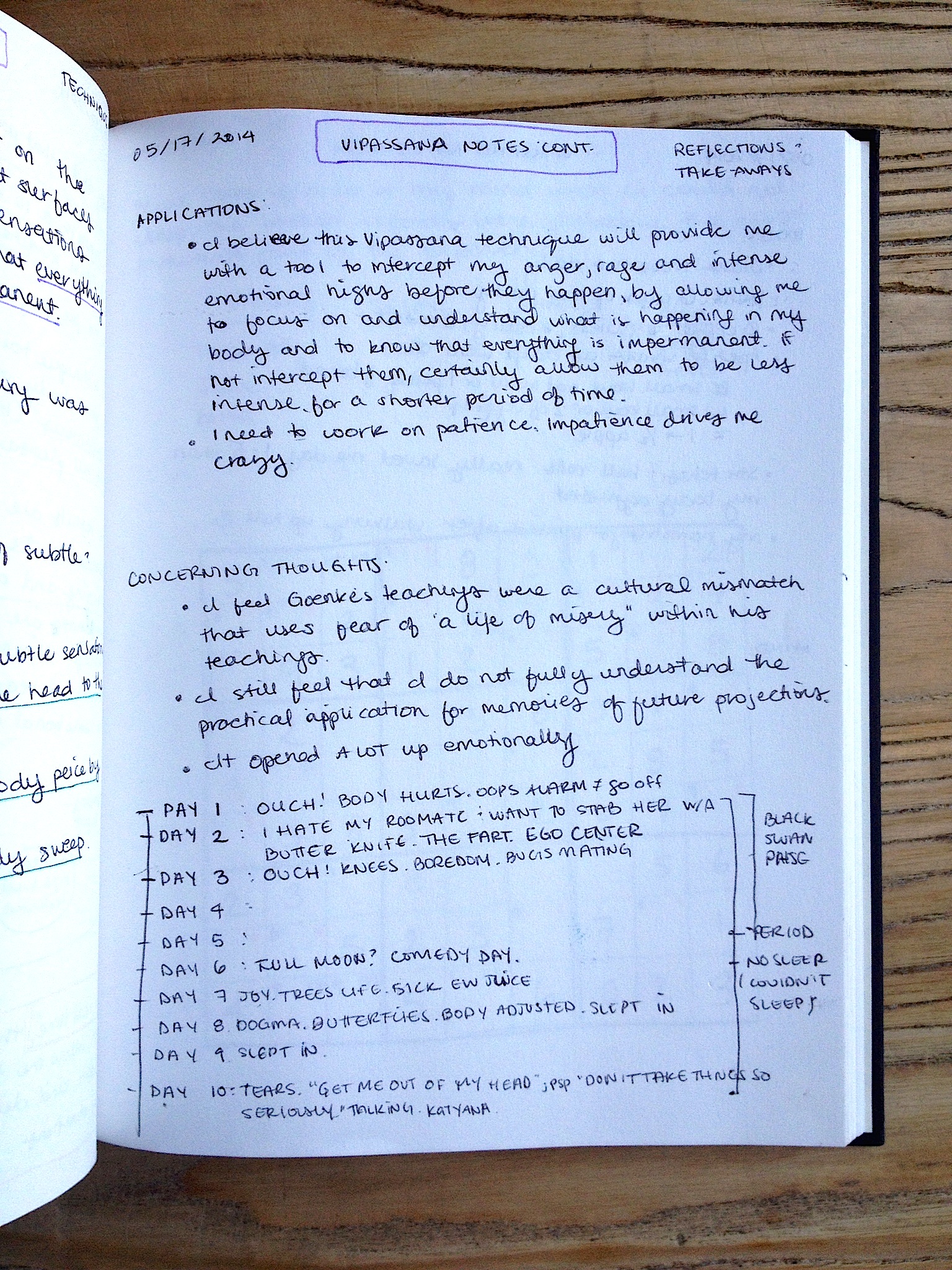
9 JunOn May 7th, I embarked no a 10-day Vipassana.
This includes all day meditation sittings with no talking, no reading, no writing, no exercise, 4a wake up bells.
Below are my notes:
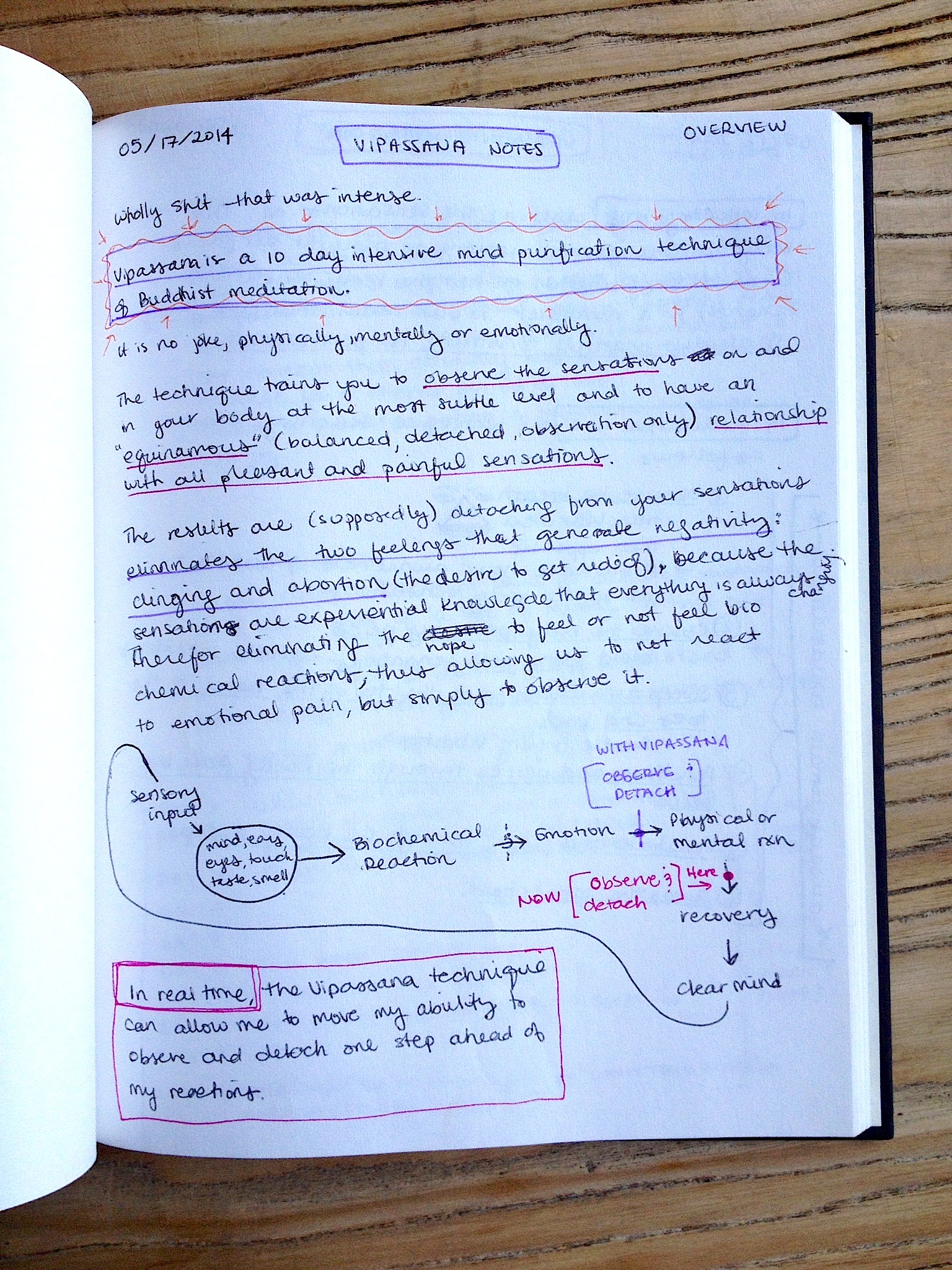
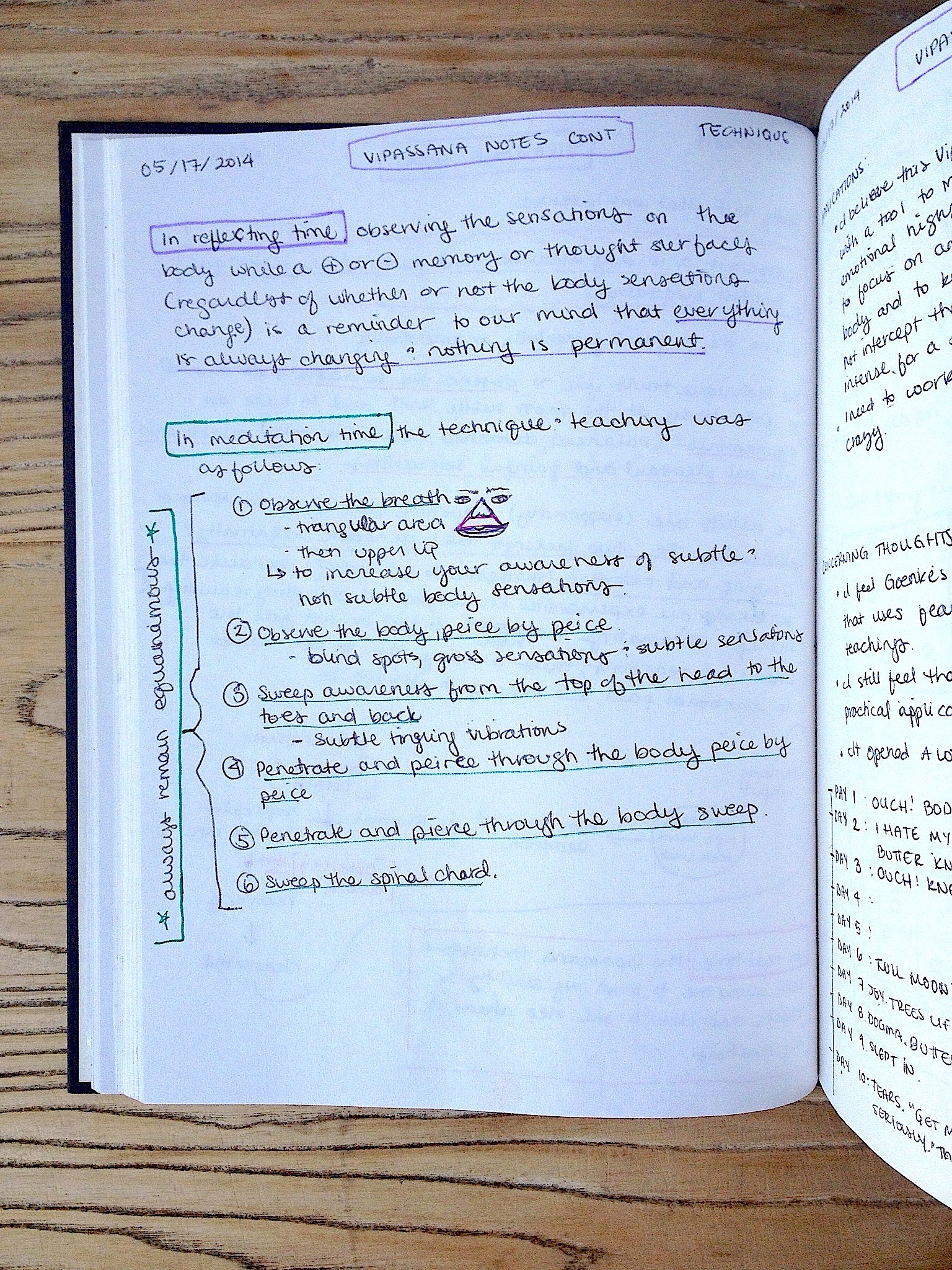
Image
Existential Lenses
2 Jun
In thinking about this existential research, I was overwhelmed with how much there is to cover (go figure… existence is kind of expansive topic). So, I decided to, instead of studying topics, adopt a series of perspectives in which to approach reality.
Here is a snap shot of day 1’s anticipated “existential lenses”
 Ph"ME"