Anthony de Mello in “Awareness”
Tag Archives: Suffering
“There’s only one evil in the world, fear. There’s only one good in the world, love. – Think of the last time you were angry and search for the fear behind it.”
16 Nov“Before enlightenment, I used to be depressed: after enlightenment, I continue to be depressed.’ But there’s a difference: I don’t identify with it anymore. Do you know what a big difference that is?”
11 NovAnthony de Mello in “Awareness” about identifying “I” with “me” on P. 59.
“When your illusions drop, you’re in touch with reality at last, and believe me, you will never again be lonely. – Lonliness is cured by contact with reality.”
11 NovAnthony de Mello in “Awareness”
“Anytime you have a negative feeling toward anyone, you’re living in an illusion. There’s something seriously wrong with you. – Something has to change. – The world is alright. The one who has to change is you.”
11 NovAnthony de Mello in “Awareness”
“Suffering exists in “me”, so when you identify “I” with “me,” suffering begins.”
11 NovAnthony de Mello in “Awareness”
Buddhism
15 JunPersonal Intro
As I researched Buddhism, I found that I was much more attracted to the philosophical applications than the religious ones (not very surprising if you know me). My attraction towards Buddhism started around 2 – 3 years ago, and has grown increasingly. Mostly, I have been attracted to the encouragement within Buddhism to question teachings, take nothing on blind faith, and to realize and experience truth for oneself. Meditation has also started to play a significant role in my life, and most recently, my 10 day silent Vipassana mediation (which is Buddhist in its origin), further increased my curiosity in Buddhism through its teachings and discourses.
1) Craving and Desire: My Bad Habit
During my 10-day Vipassana, I was introduced to the “truth” that “clinging to” or “craving of” positive sensations causes suffering (one of Buddhism’s Four Noble Truths). I had somewhere along the way already gained the understanding that “hate and aversion” cause suffering, and although I had connected the dots of how my high expectations often led to disappointment (and occasional pouting), I had never realized the full extent and frequency of my internal craving habit. This pattern of romanticizing a future life-event, and craving its imagined outcome was addictive and captivating; however, immense disappointment frequently followed when life unfolded with its own set of plans.
Note: I use “Craving”, “Desire”, “Clinging” and “Attachment” interchangeably. I also do the same with “Aversion” and “Hate”
2) No Reincarnation? No Kidding.
The desire to “know what I am talking about” is a central drive to my existential research. I was delighted, then, to discover my false perceptions about Buddhism and reincarnation. Despite what I thought, Buddhist believe in rebirth, not reincarnation. The very important difference here, is that Buddhists believe in the “no-self”, which means there is no unique, individual soul or essence that carries over from one lifetime to the next. Do I believe in rebirth? Reincarnation? Time between lifetimes? The self-soul? The no-self?
3) The No-self
This concept in Buddhism is challenging to understand, yet an essential understanding for practitioners. I am open to assistance in understanding”what” is actually reborn if there is “no self.” One school of Buddhism, Theravada considers “no-self” to mean that an individual’s ego or personality is a delusion. In another, “emptiness’ is applied, meaning all phenomena are void of intrinsic identity and take identity only in relation to other phenomena.[3]
4) Enlightenment, Liberation, Nirvana, Awakening
The clarification of terms here was really important to me, because “enlightenment”, “nirvana”, and “liberation” are so often interchanged. Within all of that there is some “awakening”. The distinction amongst them all still remains a bit unclear.
5) Question/Theory?: Is it me, or is 30-35 a ridiculously important time for profound transformations?
6) Applied Buddhism
Currently, I look forward to becoming aware of my “craving” when it happens, and practicing an “equanimous” approach towards it. I also look forward to integrating compassion meditation into my daily meditation routine.
Check out my Buddhism Conceptual Organization Chart
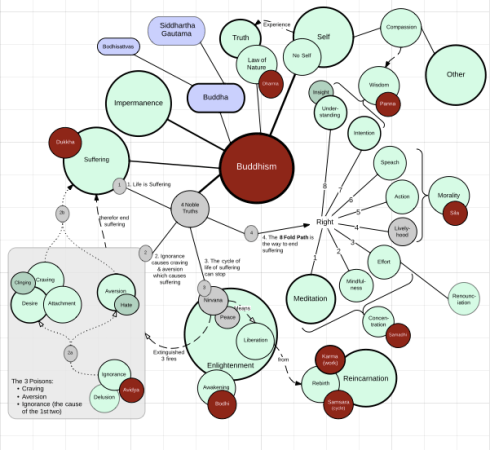
BUDDHISM
Buddhism is defined as a non-theist religion and at times considered a philosophy. It is recognized as one of the fastest growing religions in the world. [1]
TEACHINGS
The teachings of Buddhism can be summed into:
- lead a moral life
- be mindful and aware of thoughts and actions
- develop wisdom and understanding.{2]
FOUR NOBLE TRUTHS
There are Four Noble Truths which are regarded as central to the teachings of Buddhism. The four truths are:
- Suffering (dukkha) is always a part of life.
- Suffering is caused by the 3 “poisons” or “fires”: 1) Aversion to pain and death. 2) Craving/desire and the anxiety of and holding onto things, and 3) the root of the first two, ignorance.
- The end of suffering is possible.
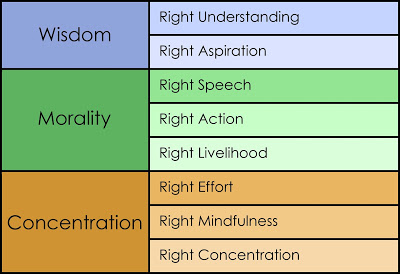
- The path to ending all suffering is achieved through a set of eight interconnected factors or conditions.
THE PATH TO END SUFFERING
Buddhists believe there are eight significant dimensions of one’s behavior that operate in dependence on one another and define a complete path, or way of living. In summary, the Noble 8-fold Path is being moral (through what we say, do and our livelihood), focusing the mind on being fully aware of our thoughts and actions (this is where meditation comes into play), and developing wisdom by understanding the Four Noble Truths and by developing compassion for others.
THREE MARKS OF EXISTENCE
Three Marks of Existence are impermanence, suffering, and not-self.
THE FOUR IMMEASURABLES
The “Four Immeasurable Minds” in Buddhism are without egotism, and are love, compassion, joy, and equanimity.
THE 5 PRECEPTS
The moral code within Buddhism is the precepts, of which the main five are: not to take the life of anything living, not to take anything not freely given, to abstain from sexual misconduct and sensual overindulgence, to refrain from untrue speech, and to avoid intoxication, that is, losing mindfulness.
With regards to the “not taking the life of anything living”, I was excited to learn that vegetarianism is not required in all Buddhist practices.
THE THREE JEWELS of which Buddhist take refuge in are:
- The Buddha
- The Dharma – Law of nature/reality
- The Sangha – monk community or community of those in Buddhism
WHERE & SCHOOLS
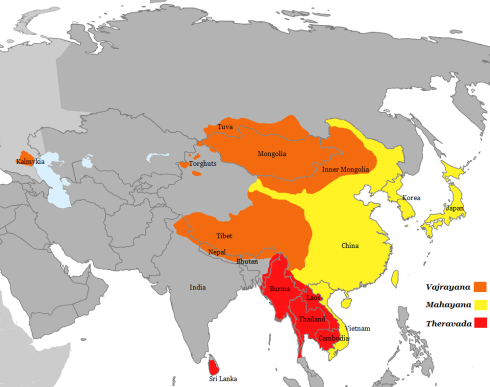
Two major branches of Buddhism are generally recognized: Theravada and Mahayana.
REBIRTH, NOT REINCARNATION
According to Buddhism there is ultimately “no-self” is no such thing as a self independent from the rest of the universe; therefor, Buddhism rejects the concepts of a permanent self or an unchanging, eternal soul, as it is called in Hinduism and Christianity. In Buddhism, Rebirth refers to a process whereby beings go through a succession of lifetimes as one of *5 (Theravadins) or 6 (other schools) possible forms of sentient life (1. hellish beings, 2. ghosts, 3. animals, 4. humans, 5. Gods and angels, *6. Asuras: lowly gods and demons, ). Each reincarnation is considered to happen back to back, and is determined by Karma.
In Tibetan Buddhism, there is an intermediate state, a “Bardo” between one life and the next.
ENLIGHTENMENT, NIRVANA & LIBERATION
It varies depending on the school of buddhism, but originally, enlightenment (Bodhi) and achieving nirvana meant the same thing. Somewhere down the line, the Mahayana school applied nirvana to the elimination of aversion and craving, and enlightenment as the further elimination of delusions and ignorance. I recall the Vipassana teacher saying that for householders (non-monk Buddhists), liberation is possible, but not enlightenment, but again, the distinction amongst these terms is unclear.
BUDDHA
Buddhism teachings started with Siddhartha Gautama, who is commonly known as the Buddha. Buddha means “the awakened one” and refers to all enlightened beings, past, present and future.
At the age of 35, Guatama Buddha famously sat in meditation under a sacred fig tree — known as the Bodhi tree — in the town of Bodh Gaya, India, and vowed not to rise before achieving enlightenment. After many days, he arose as a fully enlightened being
References
[1] “Buddhism” – Wikipedia (http://en.wikipedia.org/wiki/Buddhism)
[2] “Basic Buddhism Guide” – BuddhaNet (http://www.buddhanet.net/e-learning/5minbud.htm)
[3]”Buddhism Basic Beliefs” – About.com (http://buddhism.about.com/od/basicbuddhistteachings/a/basicshub.htm)
 Ph"ME"