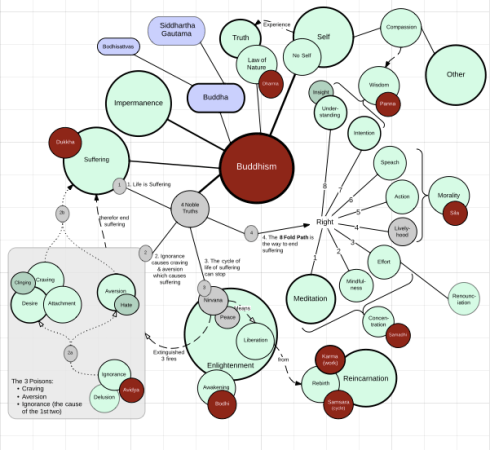
Click here to view the chart in full.
Personal Intro
As I researched Buddhism, I found that I was much more attracted to the philosophical applications than the religious ones (not very surprising if you know me). My attraction towards Buddhism started around 2 – 3 years ago, and has grown increasingly. Mostly, I have been attracted to the encouragement within Buddhism to question teachings, take nothing on blind faith, and to realize and experience truth for oneself. Meditation has also started to play a significant role in my life, and most recently, my 10 day silent Vipassana mediation (which is Buddhist in its origin), further increased my curiosity in Buddhism through its teachings and discourses.
1) Craving and Desire: My Bad Habit
During my 10-day Vipassana, I was introduced to the “truth” that “clinging to” or “craving of” positive sensations causes suffering (one of Buddhism’s Four Noble Truths). I had somewhere along the way already gained the understanding that “hate and aversion” cause suffering, and although I had connected the dots of how my high expectations often led to disappointment (and occasional pouting), I had never realized the full extent and frequency of my internal craving habit. This pattern of romanticizing a future life-event, and craving its imagined outcome was addictive and captivating; however, immense disappointment frequently followed when life unfolded with its own set of plans.
Note: I use “Craving”, “Desire”, “Clinging” and “Attachment” interchangeably. I also do the same with “Aversion” and “Hate”
2) No Reincarnation? No Kidding.
The desire to “know what I am talking about” is a central drive to my existential research. I was delighted, then, to discover my false perceptions about Buddhism and reincarnation. Despite what I thought, Buddhist believe in rebirth, not reincarnation. The very important difference here, is that Buddhists believe in the “no-self”, which means there is no unique, individual soul or essence that carries over from one lifetime to the next. Do I believe in rebirth? Reincarnation? Time between lifetimes? The self-soul? The no-self?
3) The No-self
This concept in Buddhism is challenging to understand, yet an essential understanding for practitioners. I am open to assistance in understanding”what” is actually reborn if there is “no self.” One school of Buddhism, Theravada considers “no-self” to mean that an individual’s ego or personality is a delusion. In another, “emptiness’ is applied, meaning all phenomena are void of intrinsic identity and take identity only in relation to other phenomena.[3]
4) Enlightenment, Liberation, Nirvana, Awakening
The clarification of terms here was really important to me, because “enlightenment”, “nirvana”, and “liberation” are so often interchanged. Within all of that there is some “awakening”. The distinction amongst them all still remains a bit unclear.
5) Question/Theory?: Is it me, or is 30-35 a ridiculously important time for profound transformations?
6) Applied Buddhism
Currently, I look forward to becoming aware of my “craving” when it happens, and practicing an “equanimous” approach towards it. I also look forward to integrating compassion meditation into my daily meditation routine.
Check out my Buddhism Conceptual Organization Chart
BUDDHISM
Buddhism is defined as a non-theist religion and at times considered a philosophy. It is recognized as one of the fastest growing religions in the world. [1]
TEACHINGS
The teachings of Buddhism can be summed into:
FOUR NOBLE TRUTHS
There are Four Noble Truths which are regarded as central to the teachings of Buddhism. The four truths are:
THE PATH TO END SUFFERING
Buddhists believe there are eight significant dimensions of one’s behavior that operate in dependence on one another and define a complete path, or way of living. In summary, the Noble 8-fold Path is being moral (through what we say, do and our livelihood), focusing the mind on being fully aware of our thoughts and actions (this is where meditation comes into play), and developing wisdom by understanding the Four Noble Truths and by developing compassion for others.
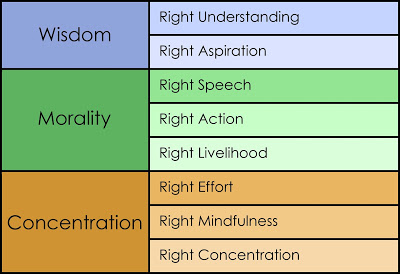
THREE MARKS OF EXISTENCE
Three Marks of Existence are impermanence, suffering, and not-self.
THE FOUR IMMEASURABLES
The “Four Immeasurable Minds” in Buddhism are without egotism, and are love, compassion, joy, and equanimity.
THE 5 PRECEPTS
The moral code within Buddhism is the precepts, of which the main five are: not to take the life of anything living, not to take anything not freely given, to abstain from sexual misconduct and sensual overindulgence, to refrain from untrue speech, and to avoid intoxication, that is, losing mindfulness.
With regards to the “not taking the life of anything living”, I was excited to learn that vegetarianism is not required in all Buddhist practices.
THE THREE JEWELS of which Buddhist take refuge in are:
WHERE & SCHOOLS

Two major branches of Buddhism are generally recognized: Theravada and Mahayana.
REBIRTH, NOT REINCARNATION
According to Buddhism there is ultimately “no-self” is no such thing as a self independent from the rest of the universe; therefor, Buddhism rejects the concepts of a permanent self or an unchanging, eternal soul, as it is called in Hinduism and Christianity. In Buddhism, Rebirth refers to a process whereby beings go through a succession of lifetimes as one of *5 (Theravadins) or 6 (other schools) possible forms of sentient life (1. hellish beings, 2. ghosts, 3. animals, 4. humans, 5. Gods and angels, *6. Asuras: lowly gods and demons, ). Each reincarnation is considered to happen back to back, and is determined by Karma.
In Tibetan Buddhism, there is an intermediate state, a “Bardo” between one life and the next.
ENLIGHTENMENT, NIRVANA & LIBERATION
It varies depending on the school of buddhism, but originally, enlightenment (Bodhi) and achieving nirvana meant the same thing. Somewhere down the line, the Mahayana school applied nirvana to the elimination of aversion and craving, and enlightenment as the further elimination of delusions and ignorance. I recall the Vipassana teacher saying that for householders (non-monk Buddhists), liberation is possible, but not enlightenment, but again, the distinction amongst these terms is unclear.
BUDDHA
Buddhism teachings started with Siddhartha Gautama, who is commonly known as the Buddha. Buddha means “the awakened one” and refers to all enlightened beings, past, present and future.
At the age of 35, Guatama Buddha famously sat in meditation under a sacred fig tree — known as the Bodhi tree — in the town of Bodh Gaya, India, and vowed not to rise before achieving enlightenment. After many days, he arose as a fully enlightened being
References
[1] “Buddhism” – Wikipedia (http://en.wikipedia.org/wiki/Buddhism)
[2] “Basic Buddhism Guide” – BuddhaNet (http://www.buddhanet.net/e-learning/5minbud.htm)
[3]”Buddhism Basic Beliefs” – About.com (http://buddhism.about.com/od/basicbuddhistteachings/a/basicshub.htm)
Note to my readers:
Hi,
As I have been conducting this existential research and following my “curriculum”, I have myself not enjoying the work. I’m constantly concerned about the reader (you); I should make my reports accurate and complete on your behalf, I should make the presentation nice, for your ease and understanding.
But, that is not what this was supposed to be about. I didn’t even know I would be blogging (and somehow having people follow my blog). I was getting lost; I found myself taking 3 days to essentially summarize a Wikipedia article on Buddhism – boring and completely unnecessary. Half of the stuff is not really of interest to me (or the only interesting thing is how it relates to my preconceptions or overlaps with other philosophies, etc).
The original intent was to actually understand words, terms, concepts, and beliefs that I casually throw around and excitedly (and often without understanding) associate myself or my experiences with. For example, how can I be an “existential researcher” without understanding what existentialism is and where it comes from? How can I say I resonate with Buddhism, if I don’t really know what it is? And thus my intent was a deeper understanding for myself, but I am getting caught up in the package of the information instead of the nuggets of gold that I hope to take with me for life.
Just a heads up that my future reports will be more inclusive of my reaction to information than copying a bunch of stuff from the internet.
Iteration #1 of many,
~ N
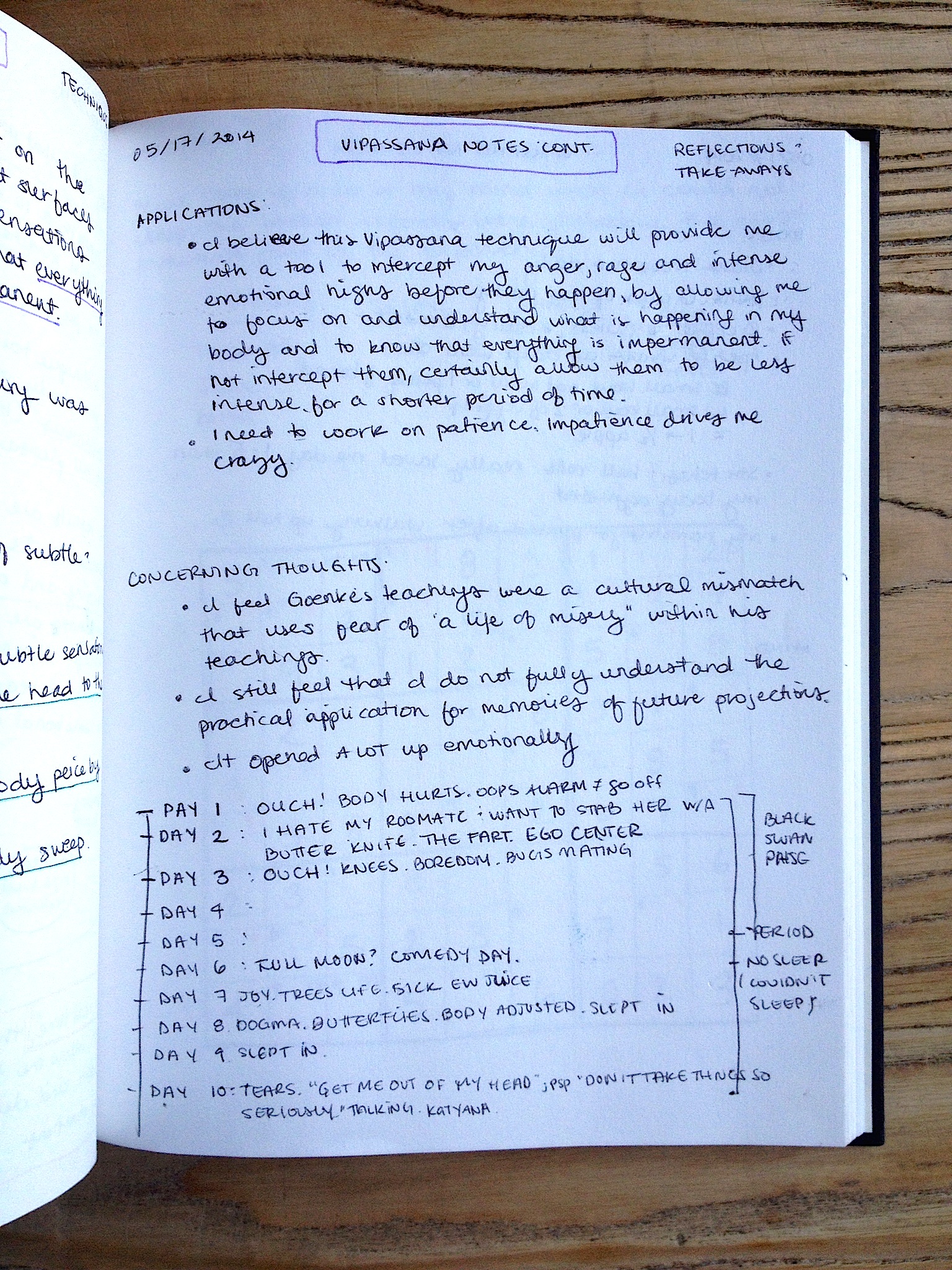
On May 7th, I embarked no a 10-day Vipassana.
This includes all day meditation sittings with no talking, no reading, no writing, no exercise, 4a wake up bells.
Below are my notes:
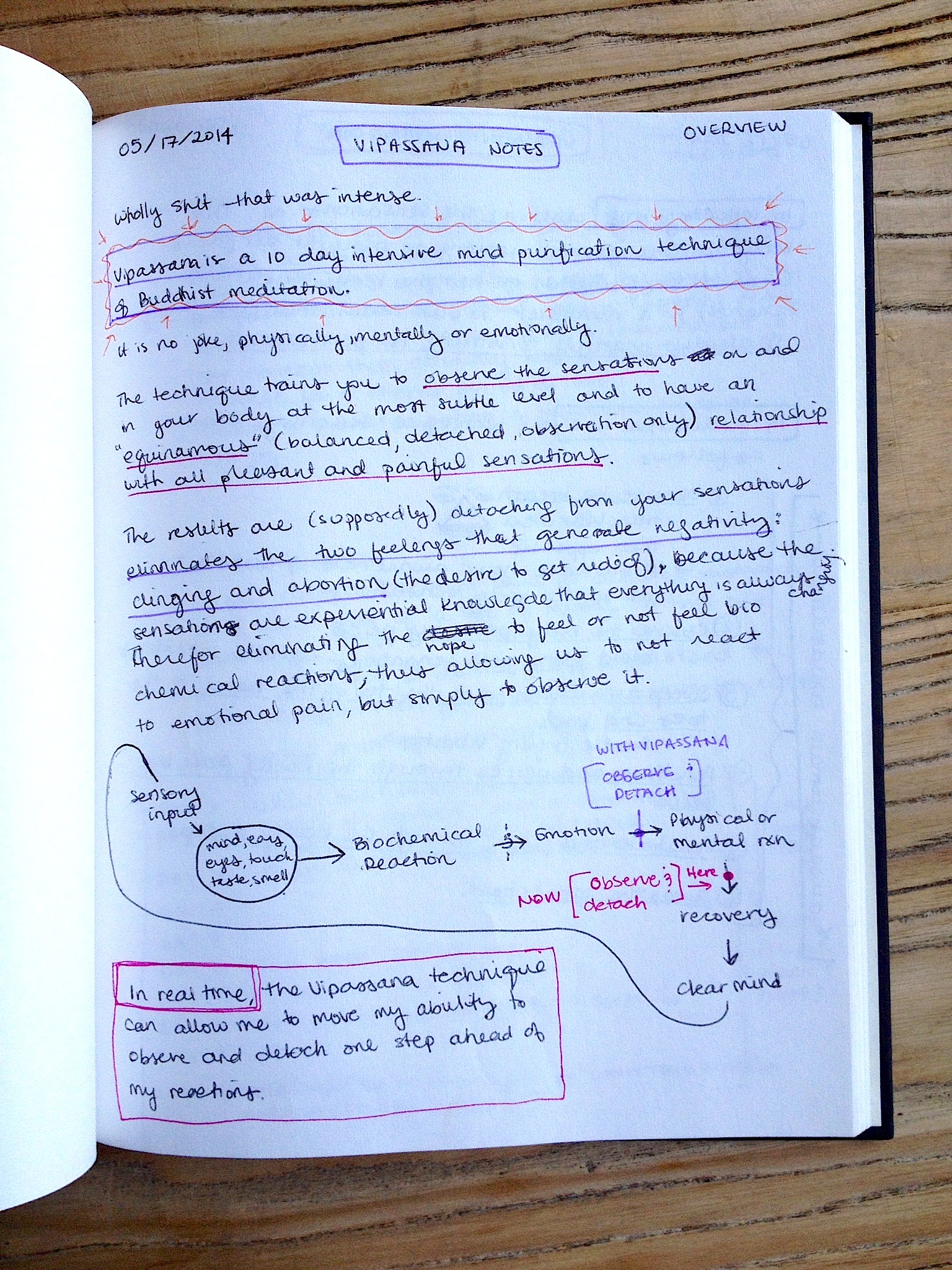
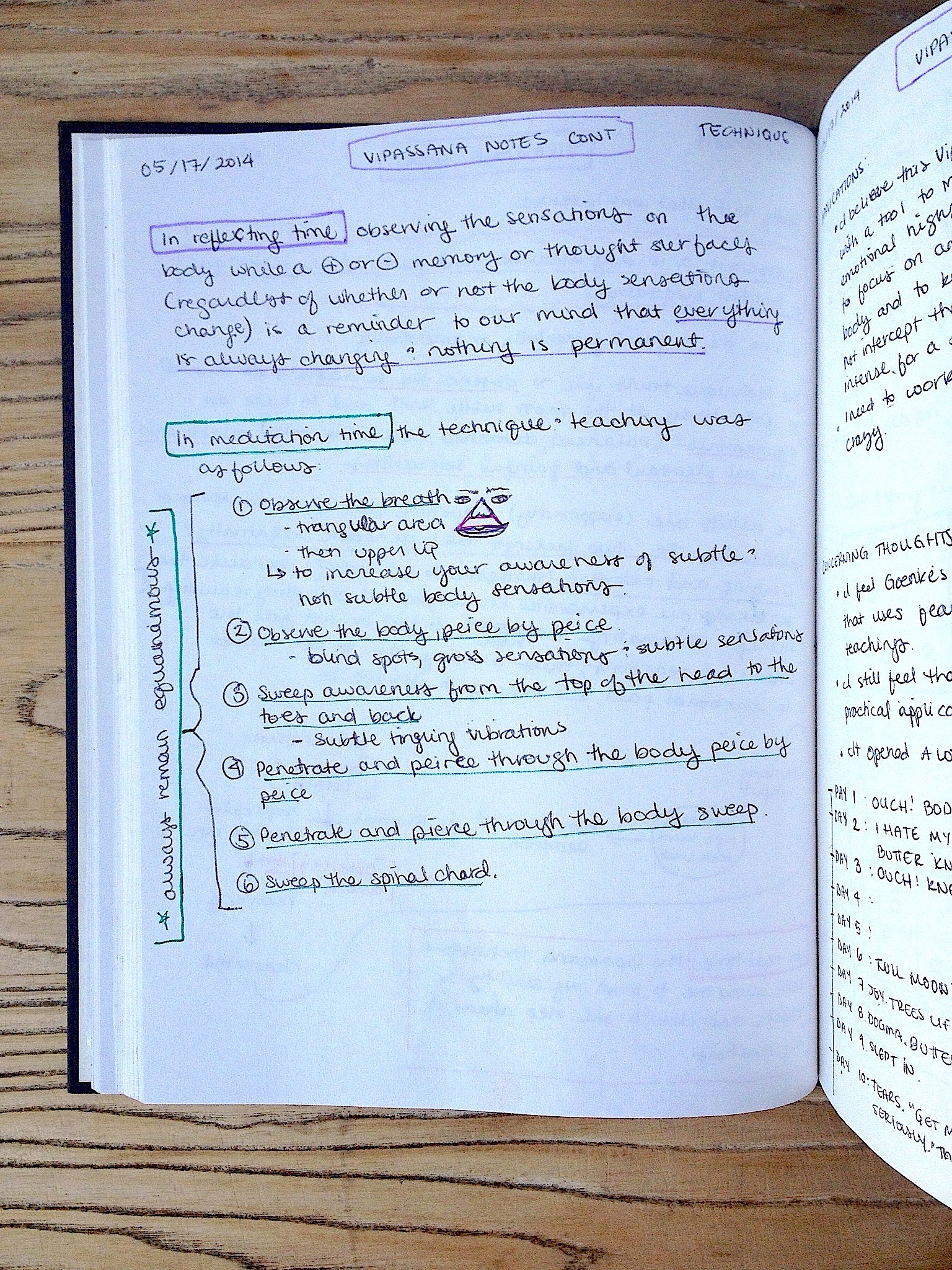
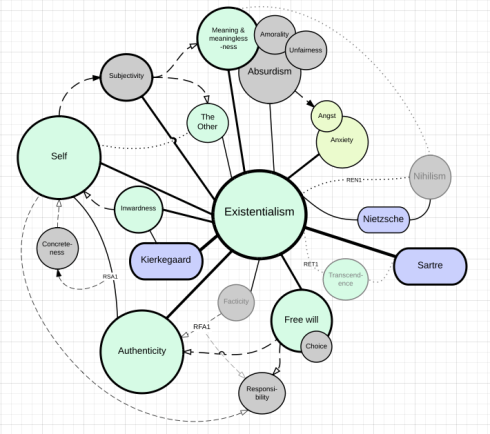
Click the graph to view layers and details in a separate window
WHAT IS EXISTENTIALISM
The way of thought by means of which
man seeks to become himself,
while approaching life from the perspective that
everything in existence is first and foremost
contextualized from the individual subject.
In true existential fashion, the previous definition is essentially my subjective choice and interpretation. According to my research and wikipedia, “there has never been general agreement on the definition of existentialism.”[1] The first two lines are actually referring to a closely-related/debatably-synonymous concept from Karl Jaspers of “Existenzphilosophie“.[1]
Existentialism lacks not only a concrete definition, but also concrete categorical placement; it is viewed as a cultural movement and a philosophical position[1][2].
I’ve interpreted existentialism in my “30ish days of Existential Research” as the study of myself to the deepest possible depth to unveal (or at least provide some strong hints) as to what constitutes my most core being and authentic self.
WHAT IS EXISTENTIALISM ALL ABOUT?
The analysis of human existence
The centrality of human choice
THE ANALYSIS OF HUMAN EXISTENCE
Existentialism centers around the belief that analysis of the human existence begins with the human subject – not merely the thinker, but the acting, living, feeling human. The analysis of one’s self is of the utmost importance because in doing so, one can understand the concrete, inward nature of his/her existence and live life passionately and sincerely (“authentically”).
“The subjective thinker has only one setting—existence—and has nothing to do with localities and such things. The setting is inwardness in existing as a human being; the concretion is the relation of the existence-categories to one another.”
– Soren Kierkegaard[1]
The authentic act is one that is in accordance with one’s freedom.[1]
THE CENTRALITY OF HUMAN CHOICE
Each individual—not society or religion—is solely responsible for giving meaning to life and living it passionately and sincerely (“authentically”).[1]
HISTORY & FIGURES OF EXISTENTIALISM
Footnotes

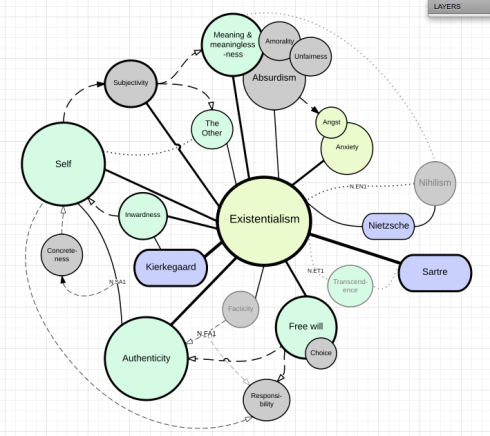
In thinking about this existential research, I was overwhelmed with how much there is to cover (go figure… existence is kind of expansive topic). So, I decided to, instead of studying topics, adopt a series of perspectives in which to approach reality.
Here is a snap shot of day 1’s anticipated “existential lenses”

 Ph"ME"